
Top categories
Top brands
Review Your Cart
Last Updated: 26 Sep, 2026
CFS

An open-plan room can look wonderfully spacious when it is empty. Furnishing it is often more complicated.
Without walls, a sofa may appear to float without purpose, the dining table can creep into the walkway and the entire room risks becoming a line of furniture arranged around its edges. The challenge is to create separate areas for relaxing and eating while allowing the room to feel connected.
Begin with the practical structure of the space rather than its decorative style. Identify entrances, kitchen access, garden doors, windows, radiators and power points before choosing new living room furniture or dining room furniture.
In most open-plan rooms, people repeatedly travel between the entrance, kitchen, table and garden. That movement creates an invisible corridor.
Do not place the dining table or the back of a sofa across this route simply because it looks symmetrical on a plan. A layout that interrupts the main path will become irritating every day.
Mark the likely walkways on your floor plan. Then position the living and dining zones beside them, not on top of them.
Allow for furniture in use. Dining chairs extend backwards when someone sits down, and recliners or sofa beds require considerably more room when opened.
A household that eats at the table every day may need a generous dining area. Another family may eat in the kitchen and use the table mainly at weekends, making a larger seating area more valuable.
Ask:
Dividing the room equally is not always the fairest or most useful choice. Allocate space according to use.
A sofa placed away from the wall can define the edge of the living area without constructing a partition. Its back creates a visual line between sitting and dining zones.
This works particularly well with corner sofas, provided the chaise points into the living zone rather than obstructing a walkway.
Check the appearance of the sofa from behind before placing it centrally. Some designs have a fully finished back, while others are intended mainly for wall placement.
Leave enough space behind it for comfortable movement. If there is room, a slim console table can make the rear view feel more deliberate and provide a surface for lighting—but it should not narrow the route unnecessarily.
Choose your dining table according to both its closed dimensions and the space needed when occupied.
Each chair needs room to pull back. People should also be able to pass behind seated diners where the layout requires it. Measure this with the actual style of chair in mind; deep upholstered seats and chairs with arms take more room than slim armless designs.
An extending table can be a sensible compromise, but mark its fully extended size on the floor. Confirm that the extension will not reach the sofa or block a doorway.
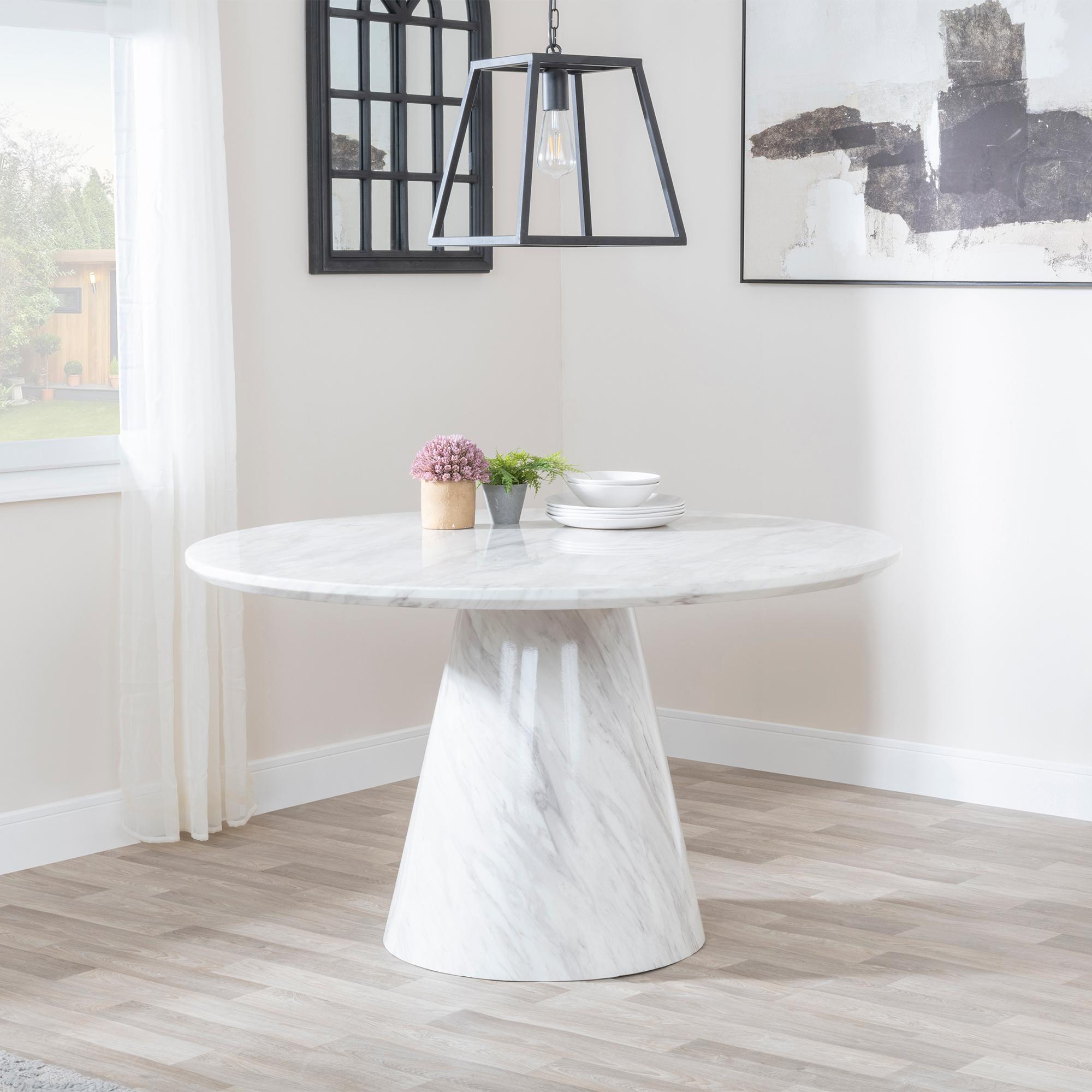
Round tables can improve movement in some compact open-plan rooms because they have no corners. Rectangular tables often follow the proportions of longer rooms more naturally.
A rug can visually anchor the seating area. It should feel connected to the sofa and chairs rather than appearing as a small island in the middle.
In the dining zone, a rug needs to be large enough for chairs to remain on it when pulled back. If that is not practical, leaving the floor bare may look better and be easier to maintain.
The two rugs do not have to match. They should, however, share something—perhaps colour, texture or level of formality—so the room still feels related.
Consider cleaning before placing a deep-pile rug beneath a table used by young children.
Buying every item from one matching range is not the only way to create continuity.
Repeating two or three elements is often enough. You might carry the warm tone of the dining table into a coffee table, repeat black metal legs in both zones or use related upholstery colours.
Avoid introducing a different timber finish on every piece. The room can quickly feel like a showroom of unrelated samples.
A sideboard placed near the dining table can connect the zones while providing storage and a serving surface. Check that its doors and drawers can open without interfering with dining chairs.
A television often dictates the living-room position more than people expect. Consider viewing angle, glare, sockets and the location of the dining zone.
If the screen is visible from the table, decide whether that is desirable. Some households enjoy an uninterrupted view; others prefer the dining area to feel separate from television time.
Position the sofa so the screen can be viewed comfortably without turning the entire seating area away from the rest of the room. An occasional chair angled between the two zones can soften the division.
One ceiling light in the centre of a large open room rarely serves every activity well.
A pendant above the dining table creates a clear centre for that zone, while floor and table lamps make the seating area feel more relaxed. The pendant should relate to the table position rather than the mathematical centre of the room.
If the table may be extended or moved, consider whether a fixed light will still align with it. Any electrical changes should be completed by a qualified professional.
Pushing everything against the outer walls may create a large empty middle but weakens the identity of both zones.
Bring the sofa forward where space allows, use the rug to anchor it and position chairs in relation to the conversation area. Place the dining set as a complete zone rather than letting it drift between the kitchen and living room.
Open-plan furniture should create useful spaces inside the room, not merely decorate its boundaries.
A plan may look perfect when the table is empty and every chair is tucked away. Test the demanding version instead.
Imagine someone cooking, another person opening the garden door, two diners pulling out chairs and a child crossing towards the sofa. If those activities can happen without collisions, the layout is doing its job.
The most successful open-plan rooms are not those with the most furniture. They are the ones where the two zones feel distinct, the routes between them remain clear and neither area seems like an afterthought.

Fitting a dining set into a small or compact living room is one of the most...

Imagine walking into your living room and feeling that everything finally connects. The...

Armchairs play a unique role in home décor, blending comfort and style together...

NEXT -- small-bedroom-furniture-layout-guide
PREVIOUS -- how-to-arrange-furniture-in-a-small-living-room
For more than 25 years, Choice Furniture has been offering the UK's best furniture brands at great prices. We've been serving as retailers of quality home furniture through beautiful showrooms located at Leicester and our newly developed state of the art online furniture store. At Choice Furniture, you will find an unrivalled selection of quality bedroom furniture, modern dining room furniture, and a large range of furniture for living rooms and modern home offices.
Our website showcases furniture sourced from the UK's best suppliers who thrive on high-quality products coupled with reasonable prices as their strongest assets. Our range offers a wide choice of furniture for every room in your house. Furthermore, we offer furniture in different types of wood and finishes such as contemporary oak furniture, shabby painted furniture, pine furniture, dark wood furniture, Indian wood furniture and classic Italian style furniture.
Our website enlists a comprehensive collection of home furniture catering to different requirements in all spheres of our lives. You will find an exhaustive list of furniture categories such as high quality beds, wardrobes for bedrooms, dining tables and chair sets, sideboards and cabinets, wall display cabinets, bookshelves and bookcases, contemporary coffee tables, TV Entertainment Units, and home computer desks.
Together with offering a great choice of furniture and the lowest prices in the industry, we take pride in remaining committed to our policy of believing that the 'Customer is King'. We are fanatical about offering an outstanding customer service experience bringing a smile on the customer's face invariably remains our topmost priority.
Delivering in:




Leave a Reply
Read our Privacy Policy